


Plug-in Battery vs Portable Power Station: What's the Difference?
They're both big boxes full of battery cells. They both come with a mains plug. And both can turn up in ads as "solar generators" or "home backup". So what's actually the difference, and does either one belong in an Irish home?

It comes down to where the electricity goes once it leaves the box. In Ireland, at the moment, that one detail changes almost everything.
Follow the sockets
A portable power station is a self-contained battery with its own plug sockets on the front. You charge it from a wall socket, much like a laptop, or from a car socket or a folding solar panel. Then you plug your lamp, laptop or fridge straight into the box. Power comes in through its charging cable, never back out through it into your house wiring.
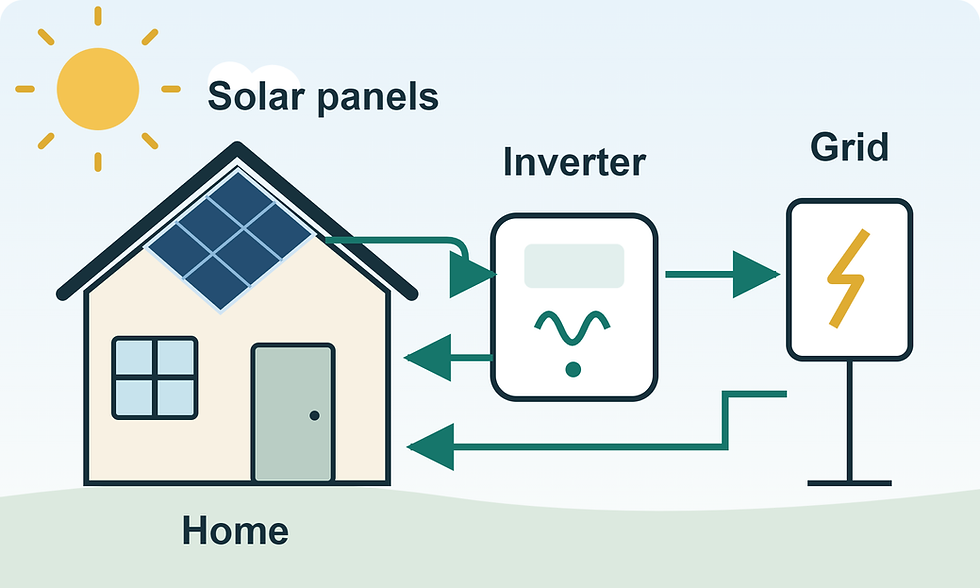
A plug-in home battery, sometimes called a balcony battery, is built to stay put, link up with your home's electricity system (often through a smart meter or a sensor at the fuseboard) and push power into your home's circuits to help run the house.
They look different, too. The portable models below hold about 1 kWh, weigh roughly 11 to 13 kg and need to be kept dry. The home batteries below hold 2.5 kWh to 5 kWh, weigh 26 to 50 kg, and carry IP65 or IP66 ratings against dust and water, so they can live outdoors, ideally somewhere sheltered. A handy rule of thumb: if you plug things into it, it's a power station. If it plugs into your house, it's a home battery.
Why that matters in Ireland
A portable power station charges from the wall and only runs what's plugged into it, so you use it like any other appliance. ESB Networks' connection rules are about equipment that works alongside the grid. A power station used this way never touches your house wiring, so those rules don't come into it, although Irish officials haven't spoken about these boxes specifically. Just follow the manual and Safe Electric's home safety advice: don't overload sockets or adaptors, and keep it away from anywhere wet.
A home battery feeding your wiring is doing exactly that, and ESB Networks treats it the same way even when it's set to "zero export". As we covered in Are Plug-in Batteries Legal in Ireland?, there's no approved way in Ireland to plug a battery into a wall socket and have it power your house.
As of late October 2026, the working group looking at plug-in solar still hadn't published its report. In the Dáil on 20 October, the Taoiseach said he'd been told it was "imminent", adding that he thought it had gone to the ESB, which wanted to be sure it was done safely. Batteries are further back: in July, ESB Networks told an Oireachtas committee it would "deal with solar first and follow on with batteries".
The route that exists today is the hardwired one. A Registered Electrical Contractor connects the battery and notifies ESB Networks using an NC6 form. The battery has to meet Irish grid standards and be approved for sale here, so not every model will qualify.
What happens in a power cut?
Two numbers matter. Capacity, in watt-hours (Wh) or kilowatt-hours (kWh), is the size of the tank. Power, in watts (W), is how fast it can pour, or how much you can run at once.
Here's the bit that surprises people: a standard grid-connected battery or solar system switches itself off in a blackout. That's deliberate: anti-islanding protection stops your system sending power down a line that ESB Networks crews may be working on. If you want a battery to keep your house circuits live in an outage, ESB Networks says a Registered Electrical Contractor must design, install and test it with a proper changeover switch. It also warns never to plug backup power into an ordinary wall socket to feed the house, as that "could endanger you, your neighbours and ESB Networks' staff".
This is where a portable power station earns its keep: you simply plug the essentials into it. The three home batteries below each have a backup socket on the unit that does the same job when the grid goes down.
Three catches are worth knowing about.
The kettle test. The power stations below are rated for 1,500 W to 1,800 W of continuous output. That's plenty for a broadband router, a laptop or lamps, and usually a fridge, as long as the box can handle the kick when its compressor starts. A kettle rated above 1,800 W won't run at full power on any of them, so check the label on yours. On paper, 1,000 Wh would run a 15 W router for over 60 hours, though losses and the box's own power use cut that down.
The switchover gap. In pass-through mode, the box sits between the wall and your device and switches to battery if the power drops, taking 20 to 30 milliseconds. A lamp or router won't notice, but two of the makers below say this isn't a true zero-gap UPS for servers or workstations. If anyone at home relies on powered medical equipment, check with its supplier first.
The quiet timeout. Some power stations switch off their sockets to save energy when they think nothing's running. One model below does it after 12 hours if the load is 25 W or less, which could catch out a broadband router overnight. Another manufacturer warns that a fridge cycling on and off can trigger the same shutoff. You can usually turn this off, ideally before you need it.
Can either one cut your bill?
The idea is to fill up on cheap night-rate electricity and use it at peak-rate times, as we explained in Home Batteries Without Solar, Tell Me More. There's also the SEAI €600 battery grant (how to apply).
A portable power station isn't really built for this, though some can be set to charge at cheaper times. It holds around 1 kWh, only powers what's plugged into it, and loses energy converting the wall's AC to stored DC and back. Its inverter also uses some power just being switched on, so any saving is limited to the one or two things plugged into it. It won't get you the grant either: that's for fixed systems of at least 5 kWh, fitted by an SEAI-registered contractor.
Bigger home batteries lose energy too. When German tech site CHIP tested the Jackery SolarVault 3 Pro, charging from the grid and sending it back to the house returned 77.2% of the energy. So you buy about 1.3 kWh of cheap electricity to get 1 kWh back. CHIP also measured a standby draw of 10.1 W, which would come to about a quarter of a kWh if it sat idle all day, or 14.4 W with the backup socket left on. For the sums to work, you need a decent gap between night and peak-rate prices, or spare solar to soak up.
What's on the market
Portable power stations. The EcoFlow DELTA 2 (1,024 Wh, 1,800 W output, 30 ms switchover, about 12 kg), Anker SOLIX C1000 (1,056 Wh, 1,800 W, 20 ms, 12.9 kg) and Jackery Explorer 1000 v2 (1,070 Wh, 1,500 W, 20 ms, about 10.8 kg) are good examples. The Jackery is the one with the 12-hour timeout. These are manufacturer figures, and all three manuals say to keep them dry.
Plug-in home batteries. The Anker SOLIX Solarbank 4 E5000 Pro holds 5,024 Wh, weighs 50 kg and is rated IP66, sealed against dust and powerful water jets (our review roundup). The EcoFlow STREAM AC 5000 (5,024 Wh, 44.6 kg, IP65) has no solar input of its own (our overview). The Jackery SolarVault 3 Pro is 2,520 Wh nominal, 26 kg and IP65 (our overview). None is an approved plug-and-go product in Ireland. In the UK, Anker's manual says its socket mode isn't currently permitted, and Jackery says SolarVault 3 isn't a plug-in socket product and needs a qualified electrician.
The one that blurs the line. EcoFlow's PowerStream microinverter can link a portable DELTA 2 to a home circuit through a socket. In Ireland, that puts it in the same position as a plug-in home battery: no approved plug-in route. For the hardwired route, ESB Networks asks people to choose equipment from its register of low-carbon devices, and PowerStream wasn't on the early-October version.
Which one fits your home?
For power cuts, camping trips or keeping the broadband going, a portable power station is the simpler buy. Used on its own, it never touches your house wiring, so there's no electrician involved; just mind the kettle, the switchover gap and that timeout.
To run the house on stored cheap-rate or solar electricity, you need a home battery. For now, that means hardwiring by a Registered Electrical Contractor, an NC6 notification and, for 5 kWh or more, possibly that €600 grant.
Plugging a battery straight into the wall will have to wait. ESB Networks has said batteries will follow solar, and the plug-in solar report hasn't landed yet. When it does, we'll look at what it means for batteries.
Note: At the time of writing, Techknow Ireland has no commercial relationship with any manufacturer or provider of portable power stations, home batteries or solar products.
Techknow Ireland is not responsible for the content of external or third-party sites.


Comments